
Assessing Your Trees After a Winter Storm
It’s that time of year again when weather forecasts have us all looking up toward the sky in anticipation, but when you do you may also want to look a bit lower and assess your trees. If you have trees, especially large trees, near your home or in your yard
It’s that time of year again when weather forecasts have us all looking up toward the sky in anticipation, but when you do you may also want to look a bit lower and assess your trees. If you have trees, especially large trees, near your home or in your yard it is always a good idea to go out and make an assessment of their health prior to and after a storm. Here are some of the most common issues and/or things to look for in your trees:
- Over extended branches particularly if they are over your home.
- Broken, cracked, dead, or otherwise damaged branches.
- Co-dominant stems (multiple trunks)
- Root failure, often most detectable by the appearance of a bulge in the soil near the tree.
- Tree species, size, and age.
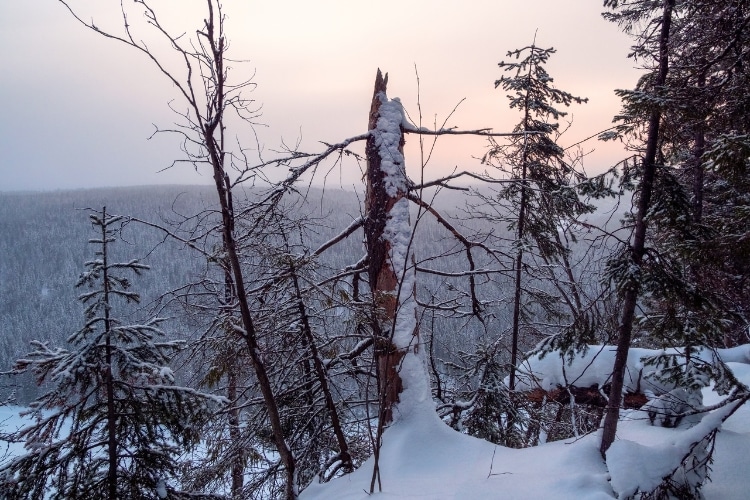
When assessing your tree start by standing back and looking from a bit of a distance. Begin with the base of the tree and scan with your eyes upward assessing the trunk, lower branches, and upper branches to make sure there is not a hazard present before you approach the tree.
Look for dead limbs which more easily stand out but also keep your eyes peeled for any broken or cracked branches. Over extended limbs can gather huge amounts of snow and could pose a problem. Take a look at the trunk and look for cracks or any splitting.
If your tree has one or more co-dominant stems (trunks) it’s best to look at them before the storm to assess whether their connection points look strong, and then after the storm check that there hasn’t been any separation of the trunks. If your tree has a lean to it take note of its position prior to the storm. Most likely your tree has just grown at an angle and has self corrected and does not pose any significantly greater risk of failure than any other tree. If the lean appears to have increased take a look at the ground around the base of the tree on the opposite side of the lean. If the soil is uplifting then it’s time to call an arborist to come in and make a professional assessment.
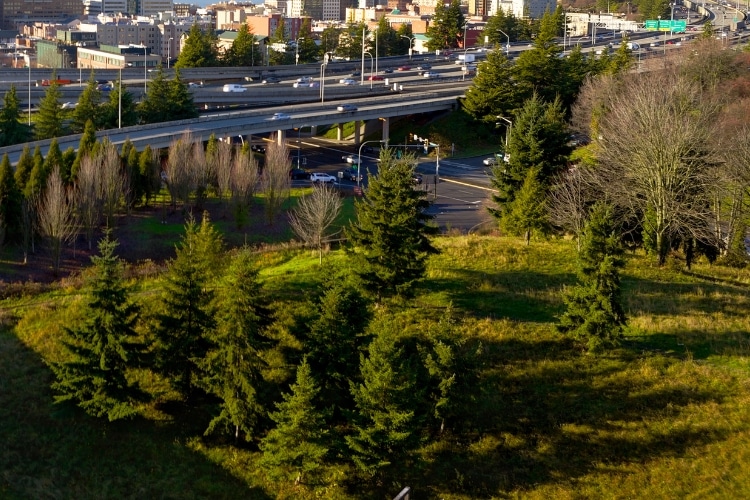
Also consider the tree species, size and age. Some types of trees are quick growing which is great but can mean weaker wood leading to more storm damage. Tree size and age typically go hand in hand so consider how great a threat your tree poses based on its size and placement on your property.
At the end of the day if you have trees on your property there is always going to be the potential for storm damage and the best way to prevent catastrophic issues is to perform these assessments annually or whenever there is a storm. Seeking professional help from a Certified Arborist can mitigate the risk posed by your tree, and a little work and care up front can prevent a massive headache after a large storm.


SEE MORE ARTICLES FROM OUR b(LOG)
We've got you covered with tips, resources, updates, how-to's, and other helpful information about trees and landscapes in Seattle, Puget Sound, and King County, WA. Join the thousands of smart local residents who get the monthly newsletter from Seattle Tree Care for helpful information you won't want to miss!
There's no spam - we promise! We are committed to keeping your e-mail address confidential. We do not sell, rent, or lease our contact data or lists to third parties.