
A Guide to Bellevue Tree Removal Permits for Homeowners
Skipping a Bellevue tree removal permit can cost up to 3x your tree's assessed value. Here's when you need one, what's changed in the code, and how to apply.
A homeowner in Bellevue can now face fines of up to three times a tree’s assessed value for taking down the wrong one — and the bar for “wrong” is lower than it used to be. The City has overhauled its tree code in recent years, expanding what counts as a regulated tree and tightening the rules around removal.
If you’re planning to remove or significantly prune a tree on your Eastside property, it’s important to understand what’s allowed, what requires approval, and where exceptions apply.
Key Takeaways
- A permit is required to remove almost any significant tree (6″+ diameter at breast height, or DBH) or landmark tree (24″+ DBH) on private property in Bellevue.
- Annual removal limits are based on lot size, but a permit is still required even when you’re working within those limits.
- Hazard trees can be removed with proper documentation from a Certified Arborist, but the permit still has to be filed.
- Penalties for unpermitted removal can reach three times the assessed value of the tree, plus possible criminal charges.

A Bellevue tree removal permit must be approved before any work begins on significant or landmark trees.
Do I Need a Permit to Remove a Tree in Bellevue?
A permit is required for almost every meaningful tree removal in Bellevue, and the conditions that trigger one are broader than most homeowners expect. Under the City’s tree removal regulations, you’ll need a permit before doing any of the following:
- Removing any significant tree (6 inches or more in diameter, measured at 4.5 feet above the ground).
- Removing any landmark tree (24 inches or more in diameter, with lower thresholds for certain slow-growing native species).
- Pruning more than 25% of the live crown of a significant or landmark tree (heavy pruning is treated like removal — view pruning projects often cross this threshold).
- Any tree work in a critical area — steep slopes, wetlands, streams, or shoreline buffers — regardless of the tree’s size.
- Any work on a tree in the public right-of-way (handled separately by Bellevue’s Transportation Department).
PRO TIP — Know Your Tree Categories: Bellevue regulates two tiers of trees on private property. A significant tree is any tree 6 inches or more in diameter, measured at 4.5 feet above the ground. A landmark tree is larger at 24 inches or more in diameter, though slow-growing native species, like Pacific madrone and Garry oak, qualify at smaller sizes.
If your project doesn’t fit cleanly into one of these categories, it’s worth a quick conversation with an arborist who knows the permit requirements across the Seattle area before you assume you’re in the clear.
How Many Trees Can I Remove from My Bellevue Property Per Year?
Bellevue caps annual tree removal by lot size, with allowances ranging from 2 significant trees on smaller lots to 4 on the largest properties. Here’s how the limits break down:
- Up to 10,000 Sq Ft: 1 landmark or 2 significant trees per year, with at least 2 trees retained.
- 10,001 to 20,000 Sq Ft: 1 landmark or 3 significant trees per year, with at least 3 trees retained.
- 20,001 to 40,000 Sq Ft: 1 landmark or 4 significant trees per year, with at least 4 trees retained.
- 40,001+ Sq Ft: 1 landmark or 4 significant trees per year, with at least 8 trees retained.
These limits reset each calendar year. If a removal would drop your property below the minimum tree count for its size, replacement is required — typically 1:1 for significant trees and 3:1 (or two large conifers) for landmark trees. On properties where on-site replanting isn’t feasible, the City charges an in-lieu fee instead.
Can I Remove a Hazard Tree Without a Permit in Bellevue?
Hazard trees still require a permit, but the annual removal limits and replanting requirements don’t apply — and a Certified Arborist’s documentation is what unlocks the exception. To qualify, the hazard must be documented by a Qualified Tree Professional under Bellevue Land Use Code 20.20.900, and the file needs:
- A site assessment from an ISA Certified Arborist (or equivalent qualified professional)
- A description of the defect, the target it threatens, and the level of risk
- A recommendation supporting removal as the appropriate response
For trees in critical areas with imminent risk, removal can happen first, but the permit must be filed within 14 days. That said, most hazard trees don’t develop overnight — they reach that condition because pest, disease, or root problems went unmanaged for years, which is exactly what a proactive Plant Health Care program is designed to catch.
When a project hinges on a hazard claim, an arborist consultation before you file is what separates a clean approval from a denied permit.
What’s the Penalty for Removing a Tree Without a Permit in Bellevue?
Civil penalties for unpermitted tree removal in Bellevue can reach three times the assessed value of the tree, plus mandatory replacement and potential criminal charges in serious cases. The same penalty structure applies to topping or excessive pruning of a regulated tree, not just outright removal.
A few things to keep in mind:
- Landmark tree removal must be performed by a Washington State licensed contractor — not a side-job operator with a chainsaw.
- The City may require replacement plantings on top of the financial penalty.
- A “we didn’t know” defense rarely works, especially after the code update was widely publicized.
How Do I Apply for a Bellevue Tree Removal Permit?
Bellevue tree removal permits are submitted online through MyBuildingPermit.com, the regional portal shared with several Eastside cities. A standard application package includes:
- A site plan showing every regulated tree on the property, tagged by species and DBH.
- A written justification for the removal (declining health, structural defect, construction conflict, or qualifying hazard).
- Arborist documentation — always for hazard claims, often for landmark trees.
- A replacement planting plan when replanting is required.
Routine residential removals can be approved in a couple of weeks. Projects involving critical areas, landmark trees, or development review often take 6–8 weeks or more, especially when incomplete applications send them back for revisions. Costs vary just as widely — the City’s permit fee schedule has current pricing — and once a permit is issued, a preconstruction meeting with the Clearing and Grading inspector is required before any work begins.
What Changed in Bellevue’s Tree Code?
Bellevue significantly expanded what counts as a regulated tree and tightened enforcement, starting with the Tree Canopy Code Amendments (Ordinance 6795) and subsequent refinements under Ordinance 6851. The headline changes include:
- The “significant tree” threshold dropped from 8″ DBH to 6″ DBH (measured at 4.5 ft above the ground) — meaning many trees that were unregulated a couple of years ago now require a permit.
- The “landmark tree” definition (24″+ DBH), previously governed by a temporary ordinance, was made permanent.
- The Bridle Trails neighborhood is now subject to the same citywide rules — the separate standards that previously applied there are gone.
- A new, lower-cost permit type for limited residential removals is on the way, intended to streamline straightforward homeowner projects.
DID YOU KNOW? Bellevue’s flat thresholds (6″ significant, 24″ landmark) are very different from Seattle’s tiered tree code. If you own property in both cities, don’t assume the same rules apply — they don’t.

Landmark tree removals on Eastside properties require a Washington State licensed contractor and often involve sectional dismantling from the canopy down.
Frequently Asked Questions About Bellevue Tree Removal Permits
What is a tree protection plan, and when does Bellevue require one?
A Tree Protection Plan is a site-specific document showing how retained trees will be protected during construction. Bellevue requires one for most development projects involving regulated trees, and it must be prepared by a Qualified Tree Professional.
Who owns a tree on a property line in Bellevue?
Trees with trunks that cross a property line (boundary trees) are considered shared property. Both owners must agree — typically in writing — before the tree can be removed.
Who owns street trees or trees in the right-of-way?
Trees in the public right-of-way — including the strip between sidewalk and curb — fall under Bellevue’s Transportation Department, not Development Services. A separate approval from the Right-of-Way Division is also required, so be sure to contact them before booking any work.
How long does it take to get a Bellevue tree removal permit?
Timelines vary by project complexity. Straightforward residential removals can move quickly through the MyBuildingPermit.com system, while projects involving critical areas or development review take significantly longer. Working with an arborist familiar with the City’s process helps avoid delays from incomplete applications.
What counts as a critical area in Bellevue?
Critical areas include:
- Steep slopes
- Wetlands
- Streams and their buffers
- Shoreline zones
- Designated Environmentally Critical Areas (ECAs)
Trees within these zones are protected regardless of size or species, and removal typically requires a restoration plan from a qualified professional.

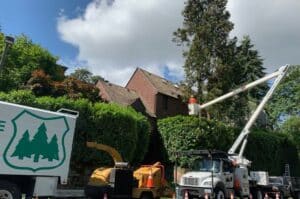
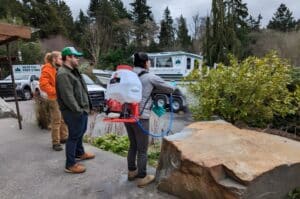
Seattle Tree Care’s crew handles every phase of a permitted tree removal — from the initial cut through final site cleanup.
Get Expert Help with Your Bellevue Tree Permit from Seattle Tree Care
A single misjudged measurement on an Eastside property can be the difference between a routine removal and a five-figure penalty — and Bellevue’s tree code keeps evolving in ways that make “routine” harder to read. If you’re planning any tree work on your Bellevue property, start by talking with someone who works with this code every day.
Seattle Tree Care has 16 ISA Certified Arborists, a Bellevue office, and a team that handles permit applications start to finish — from the initial DBH measurement to the final City approval. To start your project on the right foot, schedule your Bellevue arborist consultation online or call us at 206-222-0687.

SEE MORE ARTICLES FROM OUR b(LOG)
We've got you covered with tips, resources, updates, how-to's, and other helpful information about trees and landscapes in Seattle, Puget Sound, and King County, WA. Join the thousands of smart local residents who get the monthly newsletter from Seattle Tree Care for helpful information you won't want to miss!
There's no spam - we promise! We are committed to keeping your e-mail address confidential. We do not sell, rent, or lease our contact data or lists to third parties.