

Windstorm Tree Failure Leads to Four Poplar Removals in Queen Anne
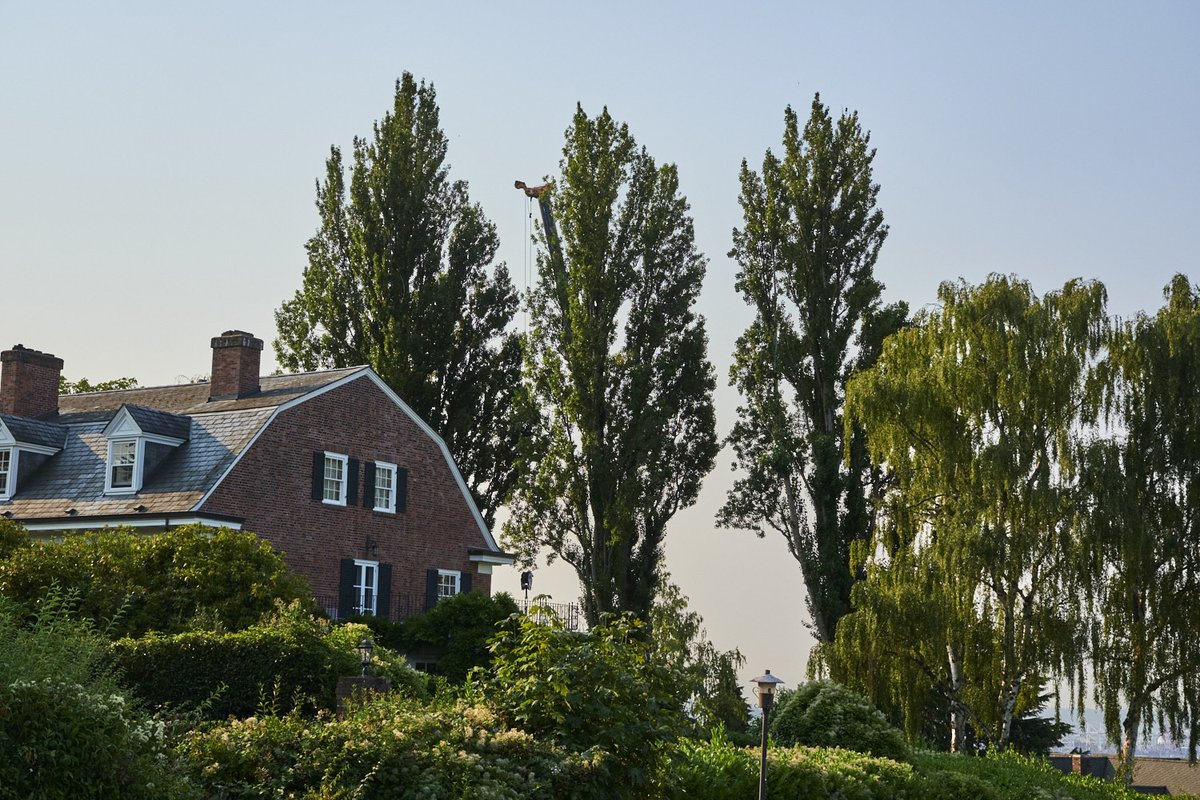
Four mature poplars originally stood on the property. After one failed at its base in a windstorm, a Level 3 assessment identified decay in the three that remained.
PROJECT OVERVIEW
Four mature poplars originally stood on this highly landscaped Queen Anne property overlooking the Seattle skyline. During a windstorm, one of the four trees failed at its base and fell across the property, prompting an emergency response from Seattle Tree Care; an arborist assessed the failed tree and the three remaining poplars while the storm was still underway.
Decay visible in the failed tree raised concerns about whether similar conditions could be present in the remaining trees. Because Seattle Tree Care did not offer Level 3 tree risk assessments at the time, the homeowner was referred to Paul Thompson with Bartlett Tree Experts for a more advanced assessment. That assessment identified decay in the three remaining poplars, and the necessary removal permit was subsequently obtained. Seattle Tree Care then returned to perform the large-scale removal, mobilizing approximately 10 crew members, an extra-large crane, and extensive processing, hauling, and traffic-control equipment.

During removal, significant internal decay and cavities became visible: evidence that a tree’s exterior does not always reveal the condition of its interior structure.
THE CHALLENGE
This project began not with a planned tree removal, but with an actual tree failure. One of four mature poplars failed at the base during a windstorm and came down across the property, immediately raising a question about the three similar trees still standing nearby.
Visible decay in the failed tree provided reason for further investigation, but determining the condition of the remaining trees required a more advanced assessment than Seattle Tree Care offered at the time. Rather than making assumptions based on the failed tree alone, Seattle Tree Care recommended a Level 3 tree risk assessment. Once that assessment identified decay in the remaining three poplars and removal was recommended and permitted, the challenge shifted from diagnosis to execution.
The trees stood within a manicured, terraced property surrounded by established landscaping, residences, and hardscape; their size and limited drop zone meant large sections could not simply be allowed to fall into the yard. Removing the remaining trees would require a highly coordinated crane operation designed to control large sections of wood while protecting the surrounding property.
ASSESSMENT
The failure of the first poplar provided an important piece of evidence: decay was present at the base of the tree that had fallen. That finding raised concern about the condition of the three remaining poplars, but Seattle Tree Care did not assume that because one tree had failed, the others necessarily would too. Instead, the company recommended further investigation through a Level 3 assessment.
At the time, Seattle Tree Care did not perform Level 3 assessments, so Paul Thompson with Bartlett Tree Experts was brought in to conduct the advanced evaluation. His assessment identified decay within the remaining three trees, supporting the recommendation for removal; Bartlett also completed the permitting process required for the work. The decision to remove the remaining trees was not based simply on their size, species, or proximity to the home; it followed an actual failure event, evidence of decay, and a detailed professional assessment of the trees that remained.

An extra-large crane was brought in to dismantle the remaining poplars in controlled sections, with the Seattle skyline and Space Needle visible beyond.
OUR APPROACH
With the Level 3 assessment completed and the removal permitted, Seattle Tree Care developed a large-scale crane-assisted removal plan for the three remaining poplars. Approximately 10 crew members were involved in the operation.
An extra-large crane was rented specifically for the project, allowing arborists to secure and control large sections of the trees before they were cut. Rather than allowing those sections to descend through the surrounding landscape, the crane could lift and transfer them into designated processing areas. The operation was supported by multiple chip trucks, large-capacity wood chippers, a grapple truck, a wood truck, extensive traffic control, and coordinated neighboring-property access.
This was not simply a matter of having a large crane: crew coordination, rigging, communication, traffic management, and material handling all had to work as one system. Once material reached the ground, a grapple was used to mechanically handle and move large sections of wood, reducing manual handling and allowing material to be efficiently processed and transported through the work zone.
WHY USE A CRANE?
Large-tree removals often involve a fundamental problem: the safest place to put a section of tree may not be directly underneath it. In a confined residential environment, gravity alone provides very little control over where large pieces travel.
Crane-assisted removal changes that. Individual sections can be secured before they are cut, allowing their weight to be transferred to the crane and moved away from structures, landscaping, and other targets: a level of control that was particularly valuable given these poplars’ size, compromised condition, and the carefully maintained landscape below. Seattle Tree Care used 4′ × 8′ mats, 3′ × 8′ mats, and plywood throughout the work area to distribute equipment loads and protect the underlying landscape.

With the compromised poplars removed, the immediate failure risk was eliminated and the property regained an unobstructed view toward downtown Seattle.
THE RESULT
Following the windstorm failure of the first poplar, the three remaining trees were successfully removed after advanced assessment identified decay within them. The crane-assisted operation allowed Seattle Tree Care to dismantle the large trees while protecting the surrounding landscaped property and managing the considerable volume of wood and debris generated by the removals.
Once the trees were gone, substantially more light reached the backyard, and the property regained an unobstructed view toward downtown Seattle and the Space Needle. The improved view was never the primary reason for removing the trees (safety was), but it became one of the most visually striking transformations of the project.
Project Facts
LOCATION
Queen Anne, Seattle, WA
PROJECT DATE
Spring 2021
TREE SPECIES
Three mature poplars (Populus spp.)
ASSESSMENT
Paul Thompson, Level 3 (Bartlett Tree Experts); Ethan Childs & Peter Gruenwoldt
CREW
Approximately 10 tree-care professionals
EQUIPMENT
Rented extra-large crane, multiple chip trucks, large-capacity chippers, grapple truck, wood truck, traffic-control equipment
By the Numbers
~10
Crew members mobilized
4
Mature poplars in the original grove
1
Extra-large crane secured for controlled dismantling
Related Case Studies

Removing a 46-Inch Beaver-Damaged Poplar at UW’s Historic Shell House
Seattle Tree Care | September 30, 2026
Beaver damage compromised a 46-inch Lombardy poplar beside UW’s historic Shell House. See how Seattle Tree Care used a crane to safely remove it.

Creating an Osprey Nest in a 100-Foot Douglas Fir in Renton
Seattle Tree Care | September 29, 2026
Instead of removing this mature Douglas-fir, Seattle Tree Care helped turn it into osprey habitat through a carefully planned nesting platform project.

We've got you covered with tips, resources, updates, how-to's, and other helpful information about trees and landscapes in Seattle, Puget Sound, and King County, WA. Join the thousands of smart local residents who get the monthly newsletter from Seattle Tree Care for helpful information you won't want to miss!
There's no spam - we promise! We are committed to keeping your e-mail address confidential. We do not sell, rent, or lease our contact data or lists to third parties.