

Common Tree Pests & Diseases in Bellevue and the Eastside
Eastside trees face different pest and disease pressures than Seattle proper. Learn what to watch for, when to act, and when to call a Certified Arborist.
This spring, the Washington State Department of Agriculture is conducting aerial treatments west of Lake Youngs in King County to eradicate spongy moth populations detected in 2024 and 2025 trapping. It’s a reminder that the Eastside tree pests and diseases threatening Bellevue, Kirkland, and Redmond properties aren’t an abstract concern.
Spongy moth is well-known, but it’s just one of many pressures Eastside trees are dealing with.
Key Takeaways
- The Eastside’s drier, warmer summers make trees more vulnerable to pest and disease pressure than trees in Seattle proper.
- Bronze birch borer and sooty bark disease are among the most active threats to Eastside landscape trees right now.
- Emerald ash borer (EAB) was confirmed in Washington state in August 2026, although not yet in King County, and preventive treatment is available for ash trees.
- Annual inspections by a Certified Arborist catch problems early, when treatment is most effective and least expensive.
Why Are Eastside Trees More Vulnerable to Pests and Diseases?
Eastside trees are more vulnerable to pest and disease pressure because the climate east of Lake Washington is significantly different from Seattle’s. Bellevue, Kirkland, Redmond, and Sammamish sit in a partial rain shadow that produces:
- Drier summers
- Warmer afternoons
- Longer stretches without measurable rainfall
Those conditions make a difference because the pests and diseases we see on the Eastside take advantage of stressed trees.
A tree that’s properly watered produces sap and resin that physically push back against borers and beetles trying to tunnel into the bark. A drought-stressed tree, however, cannot. That single dynamic, stress reducing defense, explains why bronze birch borer is so common in Eastside birches, why bark beetles are increasingly exploiting drought-stressed conifers, and why fungal diseases that need a weakened host can take hold here.
Two other factors compound the problem: the urban heat island effect through downtown Bellevue and the Redmond corridors raise temperatures further, and Eastside estate landscapes tend to feature a wider variety of high-value ornamentals. As beautiful as they are, each species of ornamentals brings its own set of pest and disease vulnerabilities.
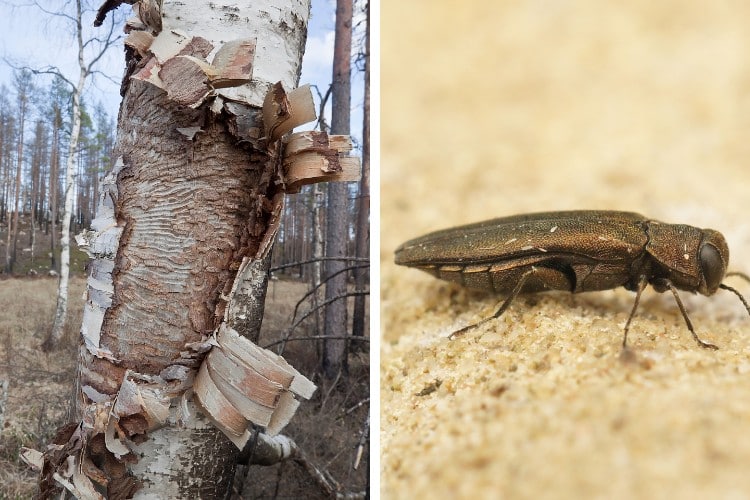
Serpentine galleries beneath the peeling bark of an infested birch (left) and an adult bronze birch borer (right)—the beetle’s tunneling beneath the bark cuts off the tree’s vascular flow.
Which Pests and Diseases Are Becoming Bigger Problems on the Eastside?
Some tree problems that used to be occasional are becoming much more common on Eastside properties, especially in mature ornamental landscapes. Birches, maples, firs, pines, and spruces are all seeing increased pressure from pests and diseases that take advantage of weakened trees. These are some of the issues Certified Arborists are monitoring most closely in Bellevue, Kirkland, Redmond, and Sammamish right now.
Bronze Birch Borer in Ornamental Birches
Bronze birch borer is one of the most destructive pests affecting ornamental birches on the Eastside, especially European white birch, Himalayan birch, and paper birch. The insect targets stressed trees, and drought conditions make birches far more vulnerable to attack.
Common symptoms include:
- Thinning foliage high in the canopy
- Branch dieback starting at the top of the tree
- Small D-shaped exit holes in the bark
- Winding larval galleries under loose bark
Deep watering during dry periods is one of the best preventative measures for mature birches. For high-value trees showing early symptoms, arborists may recommend trunk injection treatments to slow or stop infestation progression.
Sooty Bark Disease in Maples
Sooty bark disease has been confirmed in King County in recent years and tends to emerge after extended dry summers. The disease affects several maple species, including bigleaf maple, sycamore maple, and some ornamental Japanese maples.
Early symptoms often look like:
- General canopy decline
- Thinning leaves
- Branch dieback
- Reduced vigor
As the disease progresses, bark begins peeling away to expose dark, soot-like fungal spores underneath. By the time those spores appear, the infection is usually advanced. Because the spores can create respiratory issues when disturbed, infected trees should be evaluated and removed by professionals rather than handled as a DIY project.
Bark Beetles in Drought-Stressed Conifers
Bark beetles are increasingly exploiting drought-stressed firs, pines, and spruces throughout the Puget Sound region. Healthy conifers can often defend themselves by producing sap that pushes invading beetles back out of the bark. But during prolonged dry periods, stressed trees lose much of that natural defense.
Early warning signs can include:
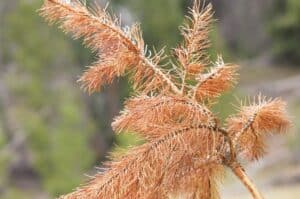
- Fading needles
- Pitch tubes on the trunk
- Boring dust near the base of the tree
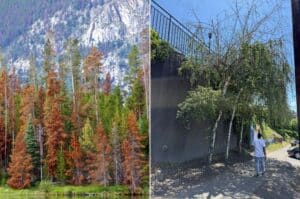
- Sections of canopy turning brown surprisingly quickly
Once a tree is heavily infested, removal is often the safest option to help reduce spread to nearby conifers.
Which Invasive Pests Should Eastside Homeowners Prepare For?
Two invasive pests deserve special attention from Eastside property owners. One has yet to arrive, and one is being eradicated right now.
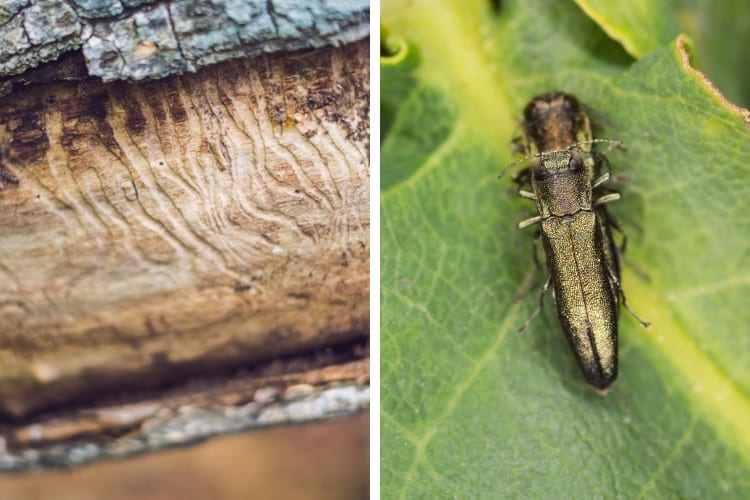
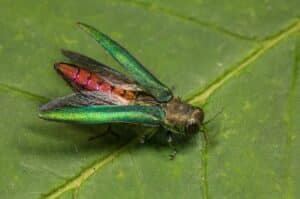
S-shaped larval galleries carved into the wood beneath ash bark (left) and an adult emerald ash borer (right)—the metallic green beetle has been confirmed in Oregon since 2022 and in Washington state, as of August 2026.
Emerald Ash Borer (EAB)
EAB is one of the most destructive forest pests in North American history. It was confirmed in Forest Grove, Oregon, in 2022, and first confirmed in Vancouver, Washington, in August 2026. There aren’t any confirmed sightings in King County yet, but untreated ash trees in infested areas rarely survive, and the ornamental ash plantings across the Eastside are completely vulnerable.
On the bright side, preventive trunk injection treatments are highly effective when applied before infestation. If you have ash trees on your property, the decision point is now. For a deeper look at identification, treatment options, and timing, see our in-depth emerald ash borer guide.
Spongy Moth
Spongy moth caterpillars defoliate hundreds of trees and shrubs, including:
- Oaks
- Maples
- Birches
- Many ornamentals common on the Eastside
WSDA has been monitoring and eradicating spongy moth introductions in Washington for some time, and the 2026 treatment is a part of an ongoing pattern: spongy moth pressure is a long-term monitoring need, not a one-season event. To learn more, check out our guide to spongy moth identification and prevention and our overview of invasive tree pests in the Seattle area.
What Other Pests and Diseases Affect Eastside Landscape Trees?
Not every tree problem on the Eastside is catastrophic, but many common pests and diseases slowly weaken trees over time and make them more vulnerable to larger threats later. Repeated insect feeding, chronic fungal infections, and ongoing canopy stress all force trees to spend energy on survival instead of defense. That matters because stressed trees are less capable of resisting borers, bark beetles, drought stress, and secondary infections.
Aphids and Scale Insects
Aphids and scale show up most often on:
- Japanese maples
- Ornamental cherries
- Other landscape trees Eastside homeowners invest in heavily
Aphids produce a sticky honeydew that drips onto cars and patios and supports sooty mold, the black coating that makes leaves look like they’ve been dusted with soot. Scale insects attach to branches and stems and slowly drain a tree’s resources, causing branch-to-branch dieback. Usually, neither is fatal on a healthy tree, but on an expensive specimen Japanese maple in a front entry, that isn’t good enough.
Treatment is most effective when it’s part of an integrated pest management program that uses beneficial insects and well-timed targeted applications.
Anthracnose and Powdery Mildew
Anthracnose is a fungal disease that affects maples, dogwoods, oaks, and sycamores, producing:
- Irregular brown patches
- Leaf curling
- Early leaf drop
Powdery mildew shows up as white, dusty coating on leaves and is favored more by dry summer air with cool nights, which better describes the Eastside than Seattle. Typically, neither kills trees, but repeated infections weaken them and degrade their appearance every year. They’re both manageable with proper pruning for airflow, well-timed fungicide applications when necessary, and ongoing monitoring.
Frequently Asked Questions About Eastside Tree Pests & Diseases
What are the most common tree pests in the Bellevue and Eastside area?
The most active pests on Eastside properties are:
- Bronze birch borer
- Scale insects
- Bark beetles
- Aphids
The Eastside’s drier summers create more drought stress, which makes trees more vulnerable to borer and beetle infestations than trees in Seattle proper.
How do I know if my tree has a disease?
Look for unusual leaf discoloration, premature leaf drop, bark peeling or cracking, dark or powdery growths on bark, and branch dieback—especially in the upper canopy. Many tree diseases share similar symptoms, so an inspection by a Certified Arborist is the most reliable way to get an accurate diagnosis.
Is emerald ash borer in Washington state?
Yes, as of August 2026, emerald ash borer has been confirmed in Washington State, but not yet in King County. If you have ash trees on your property, preventive trunk injection treatments are available now and are much more effective when applied before infestation.
Why are birch trees dying on the Eastside?
Bronze birch borer is the most common cause of birch decline on the Eastside. The beetle targets birches weakened by drought stress, and the Eastside’s drier summers make ornamental birches particularly vulnerable. Deep watering through July, August, and September—plus professional trunk injections for at-risk specimens—can protect them.
How can I protect my trees from pests and disease?
The most effective protection is a proactive plant health care program that includes annual inspections, proper watering during the dry summer months, targeted treatments when needed, and monitoring for early symptoms. A Certified Arborist can tailor a plan to your property’s specific tree species and conditions.
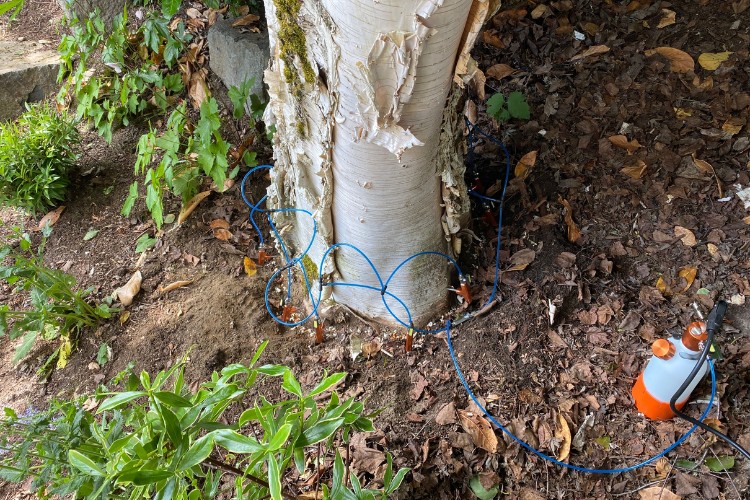
Trunk injection delivers treatment directly into a birch’s vascular system, protecting high-value specimens from bronze birch borer attack.
Protect Your Eastside Trees with Seattle Tree Care
Properties on the Eastside face a distinct set of pest and disease pressures driven by drier summers, diverse ornamental plantings, and a warming climate. With a variety currently established and active, the common theme is early action.
Seattle Tree Care’s Certified Arborists serve the Eastside from our Bellevue office, giving Bellevue, Kirkland, Redmond, Mercer Island, and Sammamish properties faster response times. Reach out to Seattle Tree Care today or call 206-222-0687 to get ahead of problems before they spread.


SEE MORE ARTICLES FROM OUR b(LOG)
We've got you covered with tips, resources, updates, how-to's, and other helpful information about trees and landscapes in Seattle, Puget Sound, and King County, WA. Join the thousands of smart local residents who get the monthly newsletter from Seattle Tree Care for helpful information you won't want to miss!
There's no spam - we promise! We are committed to keeping your e-mail address confidential. We do not sell, rent, or lease our contact data or lists to third parties.